
Interaction vs. Interactive Design

As per my previous post here, I was trying to make my own approach to the facts behind the most confusing perspectives (Reactive, Responsive, and Interactive) ..

I’ve been led to a point where Interaction and Interactive terms are quite different yet related, and as I said it is a literate issue from my point of view ..

Interaction – noun.
Interaction Design is referring design to interactivity (designing the interactivity).

Interactive – adjective.
Interactive Design is referring interactivity to design (interacting the design).

I think I need to explain more ..
If we agree with my definition to the term “Interactive” to be a two-way flow of information (communication channel) between objects and users, in other words, how information flows from objects to users and how users respond to it.
On the other hand, if we define the term “Design” to some sort of specification to an object.
Then we can say:

Interaction Design is referring to the specification of interactive objects (objects responsive to users).

Interactive Design is referring to the information flows in response to the object’s specification.

For an instance, a cell phone is in fact is an interactive object, which means it responds to user’s actions ..
Specifying how users can interact like how many buttons, shape, size, color, .. ,etc.
I call that Interaction Design.
Controlling how information flows to users based on those specifications like visual interface, sounds, vibration, animation, .. ,etc.
I call that Interactive Design.

The way I see it, when we talk about designs in which the user can interact like Architectural Design, Industrial Design, and Graphic User Interfaces, then we are in fact designing the interactive objects (Interaction Design).
And when we talk about use cases and scenarios to control the user response to certain designs like Visualizations, Animations, Sounds, and Movements, then we are in fact interacting the designed objects (Interactive Design), in other words, Moods, Expectations, and Know-how.

There is a thin line between both perspectives, but the obvious part is “Interactivity”, it is necessary for both terms (Interaction and Interactive), if the user can not interact with objects then there is no place for neither Interaction Design nor Interactive Design.
Reactive / Responsive / Interactive

Reactive is acting in response to a stimulus without proper observation (emotional over mental)
Responsive is taking appropriate action in the moment after discern and differentiate relative priorities (mental over emotional)
Interactive is allowing a two-way flow of information between parties (emotional, mental, and physical)

Interactive Design actually refers to the communication channel produced by certain design, unlike Responsive Design which creates a single reaction controlled by design.
Reactive Design is something completely different, there’s no specific actions needs to be taken in response to design, hence it’s all about emotions, so to speak!

In other words, Interactive Design could be described as a set of Responsive Designs!
To control all possible reactions there must be a well managed flow of information (Information Architecture), and to deliver those reactions there must be a well designed User Scenarios (User Experience).

In case we refer the common abbreviation IxD to Interactive Design as well, then:

IxD = IA + UX

Interaction Design and Interactive Design are not quite similar, in fact it’s a literate issue ..
Interaction Design is designing the objects with which the user can interact (Architectural, Industrial, User Interface).
Interactive Design is designing the communication channel in which the user can interact with objects (Presentation, Visualization, Advertisement).

Alternatively, Interaction Design is essential to Interactive Design, without the interaction objects there’s no place for the interactive channel!

Multitasking Illusion

What is multitasking? it is the practice or capability of handling more than one task at the same time ..

It is said that our brain is capable of performing certain dual multiple tasks at the same time, for example, listening to the radio while writing an email, increasing the amount of tasks was one of the very basic reasons for inventing the CPU from the first place ..

Well, I completely disagree, actually there is no such thing as multitasking, only context switching which simulates multitasking, even for the CPU!
Let me explain ..

Human brain and CPU are quite different, our brain is more complicated, so I will take the CPU for an easier example ..
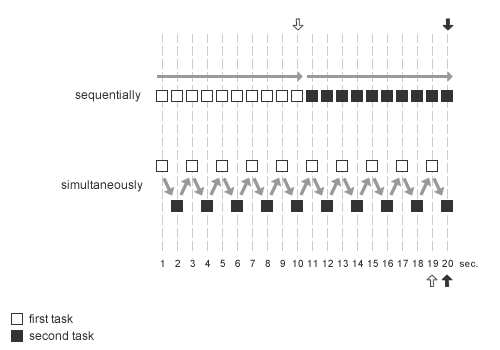
Consider that you need to perform 2 tasks on your PC, each requires exactly 10 seconds ..
The total time required will be 20 seconds for both tasks if running sequentially, first task will be completed after 10 sec and second task after 20 sec ..
But if you run both tasks simultaneously with the use of what called CPU multitasking, the CPU will do a context switch between both tasks, in other words, breaking down each task to segments and switch back and forth between them, assuming that each task will have 10 segments, each segment requires one second, then first task will be processed at odd seconds (1, 3, 5, ..) and second task at even seconds (2, 4, 6, ..), in that case we will have first task completed after 19 sec and second task after 20 sec, considering that the switch takes no time at all !!

Imagine the above procedure in our brain with the unexpected time required for the context switching, there is no accurate numbers but obviously the sequential approach will take much less processing than the simultaneous one, using only one switch between tasks !

On the other hand, human context switching (what I call distraction) means spreading attention among tasks, like talking on the phone while driving a car, since 2003 car accidents increased about 40% because of cell phones!

Observation:

  • CPU can not actually perform simultaneous tasks, it uses context switching to simulate multitasking, even with mutli-core processors, yet each core still performs exactly the same.
  • Context switching will not reduce the total time required for all tasks, it just adds an extra time for the switching operation.
  • Multitasking more accurately refers to Managed Tasking!
  • Human context switching consumes much more time than the CPU, in addition to the continuous partial attention.

Conclusion:

Never think or act simultaneously!

Facts: